
About
AREOPAGITICUM FOUNDATION
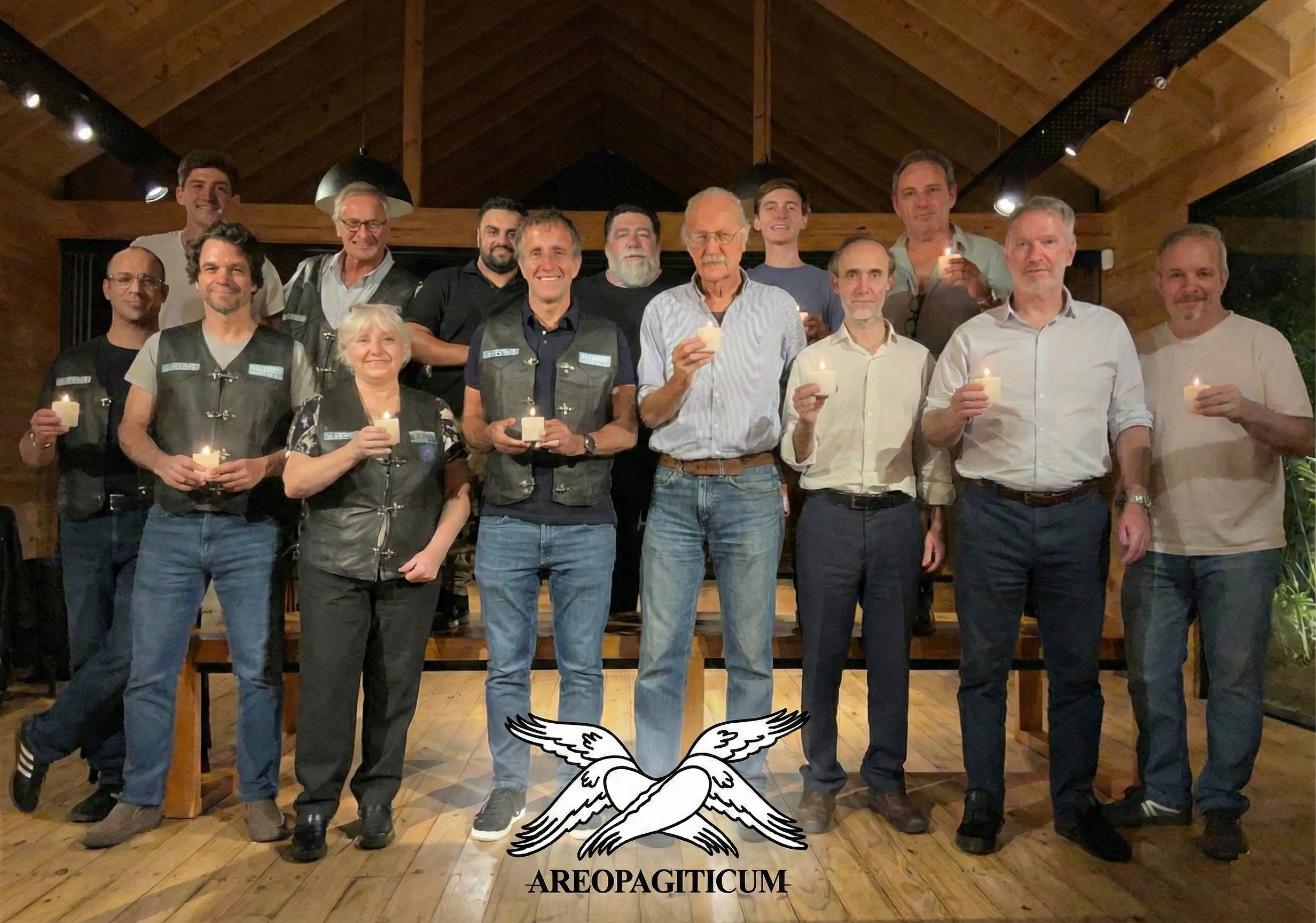
At the Areopagiticum Foundation, we have a team of experts and scholars who guide our mission to research and disseminate the legacy of Dionysius the Areopagite. Our organizational structure includes an Honorary Council composed of leading academics, an Administrative Board responsible for managing the foundation, and an Academic Committee that oversees our research activities and educational programs. Together, we work to promote the study and appreciation of Dionysian thought throughout the world.
Honorary Council
Werner Beierwaltes (☨)
Francisco Bertelloni
Pablo Adrián Cavallero
Carlos de Marcos
Enrico Peroli
Academic Committee
Associate Fellows
Leonardo Caviglia
Claudia D’Amico
Juan Pablo Roldán
José María Tejedor
Administrative Board
Editorial Committee
Tadeo Lima
Nicolás Avellaneda
SUMMER SCHOOL
WINTER SCHOOL
Juan Francisco Franck
ΕΛΛΗΝΙΚΗ ΕΚΔΡΟΜΗ
Pablo Adrián Cavallero
Juan Francisco Franck
Haris Papoulias
Commencement of Operations: November 8, 2021
Certificate of Incorporation
IGJ #1973074 11/05/22
Registro #283
Tax Identification Number
CUIT: 30-71761552-9
IVA/IIBB/GANANCIAS EXENTOS

Francisco Bastitta Harriet
He holds a PhD in Philosophy from the University of Buenos Aires (UBA).
He teaches the History of Medieval Philosophy at the UBA and at the Pontifical Catholic University of Argentina, and serves as a CONICET Researcher at the “Dr. Alejandro Korn” Institute of Philosophy (UBA). He was a Mellon Fellow at “Villa I Tatti”, Harvard University’s Center for Italian Renaissance Studies (2016), and a fellow of CONICET and of the Association Internationale d’Études Patristiques (AIEP/IAPS). He has taken part as a researcher in several interdisciplinary projects on the reception of Platonism and Hermeticism in the Middle Ages and the Renaissance. His most recent book is An Ontological Freedom: The Origins of the Notion in Gregory of Nyssa and its Influence unto the Italian Renaissance (Brill, 2023).
TADEO LIMA
He graduated in philosophy from the University of Buenos Aires and completed a Master’s degree in German Language and Literature at the University of British Columbia, Canada. Since 2013 he has devoted himself to academic translation. He has translated a large number of philosophical essays and works from English and German into Spanish, published by various publishing houses.
Francisco BERTELLONI
Francisco Bertelloni holds a PhD in Philosophy and Letters, is Emeritus Professor of the History of Medieval Philosophy at the Faculty of Philosophy and Letters (UBA) and Senior Researcher at CONICET. He directed the journal PATRISTICA ET MEDIAEVALIA. He is director of the Section of Medieval Philosophy and of the Institute of Philosophy of the Faculty of Philosophy and Letters (UBA). He has taught courses in Switzerland, Italy, Brazil, Germany and Portugal. He has published numerous articles on medieval philosophy and political theory in Argentine and foreign journals.
Gustavo Riesgo
He holds doctorates in Philosophy and in Artificial Intelligence and has more than thirty years of experience at the intersection of technology, knowledge and organisations. He is Chairman of AXIS HUMAN, founder and director of the Areopagiticum Foundation, and a pioneer in the Philosophy of Artificial Intelligence, a field in which he founded and directs the first university chair specifically devoted to the discipline, at the Universidad del Norte Santo Tomás de Aquino (UNSTA), where he also teaches. His training combines Computer Science, Artificial Intelligence and Philosophy. He holds a Licenciatura in Philosophy and a Postgraduate Specialisation in Medieval Thought from UNSTA, and a Master’s degree in Philosophy with a concentration in the Natural and Cognitive Sciences from Universidad Austral, where he carried out his research on the cognitive foundations of natural language processing. He has also completed postdoctoral specialisation studies in Artificial Intelligence and has received academic fellowships from the Arché Foundation for Advanced Anthropological Studies (UCLA), the Earhart Foundation (Blackfriars Hall, University of Oxford) and the John Templeton Foundation (Universidad Austral). His academic work brings together artificial intelligence, epistemology, cognitive science, philosophy of technology and Digital Humanities, with particular attention to the ontological and epistemological foundations of artificial intelligence. In parallel, he has conducted research on the Neoplatonic tradition and the metaphysics of light, particularly around Dionysius the Areopagite and the Corpus Dionysiacum. Through the Areopagiticum Foundation he promotes their study, reception and dissemination by means of artificial intelligence and Digital Humanities tools. A professor, researcher and lecturer, he has published translations, articles and books in his fields of specialisation, developing a career that links philosophical research with more than three decades of professional experience in artificial intelligence, technology and knowledge management.
Ezequiel Ludueña
Adjunct Professor of Philosophical Latin and Head of Teaching Assistants in the History of Medieval Philosophy, both courses in the Philosophy programme of the University of Buenos Aires. He completed his undergraduate and doctoral studies at the same university. He is managing editor of the journals Cuadernos de Filosofía and Patristica et Mediaevalia and a researcher at the Institute of Philosophy of the University of Buenos Aires. He is devoted to the study and dissemination of medieval philosophical thought, and researches in particular the thought of Eriugena, Albert the Great, Meister Eckhart and Berthold of Moosburg. He has taught courses and given lectures at universities in Latin America and Europe. He has translated and annotated texts of the ancient and medieval Platonic tradition, and has published articles in various specialised and general-interest journals. He currently directs the research project UBACyT-20020220400260BA, entitled: Medieval translators and their precursors.
Francisco O’Reilly
He holds a PhD in Philosophy from the University of Navarra and is a professor and researcher at the University of Montevideo (UM) and a Level I researcher in Uruguay’s National Research System (SNI, ANII-Uruguay). A specialist in medieval philosophy and in the reception of classical Arabic philosophy, his research has focused on the doctrinal and textual study of the Avicenna Latinus and its assimilation into thirteenth-century scholasticism. In a range of specialised publications he has examined the noetics of the Liber de anima and Avicenna’s Philosophia prima / Scientia divina, analysing the interweaving of the Aristotelian model with Neoplatonic emanationist schemes. His work also addresses the first Latin reception of Arabic thought in the twelfth century, focusing on the Toledo circle of translators (Dominicus Gundissalinus) and the transmission of fundamental sources such as the Liber de causis, tracing the articulation of first causality, the hierarchy of ontological principles and the doctrine of the reditus towards the One.
Haris Papoulias
Haris Papoulias (Athens, 1982) holds a PhD and a Dr. Europaeus in Philosophy and the History of Philosophy (Università del Piemonte Orientale, Italy) and is a professor of philosophy in the Department of Philosophy and Society at the Complutense University of Madrid, where he teaches Aesthetics in the Philosophy degree and Ancient and Medieval Aesthetics in the Art History degree. He is a member of the University Institute for the Sciences of Religions at the UCM and philosophy officer of the Spanish Society of Byzantine Studies. As a visiting professor at the National Scientific and Technical Research Council (Conicet) in Buenos Aires, he is conducting research on photography, rhetoric and social justice.
He has worked on the history of visual culture and German idealism, a field in which his monograph Iconoclastia endogena. Una teoria dell’immagine hegeliana, with an introductory essay by Félix Duque (Milan: Mimesis, 2019, 630 pp.), stands out. In recent years his lines of research have centred on ancient and Byzantine aesthetics and their contemporary reception. In this field he has produced an annotated edition of Dionysius Longinus’ treatise On the Sublime (Madrid: Alianza editorial, 2022) and edited the monographic issue of the Revista Española de Retórica devoted to Aesthetics and Rhetoric (3/2026). He is currently preparing, at the request of Alianza editorial, an annotated edition of Plotinus’ Enneads on Beauty.