
ΕΛΛΗΝΙΚΗ ΕΚΔΡΟΜΗ
Triennial study trip · First edition: February 2028
Ελληνική Εκδρομή —“Greek excursion”— is the Areopagiticum Foundation’s triennial study trip: every three years, a group travels to the places where the tradition the Foundation studies and promotes was born and handed down. The first edition will take place in February 2028, joining Greece and Rome; later editions will take the journey to other topoi of that tradition, such as Sicily or Cappadocia.
2028 EDITION · GREECE AND ROME
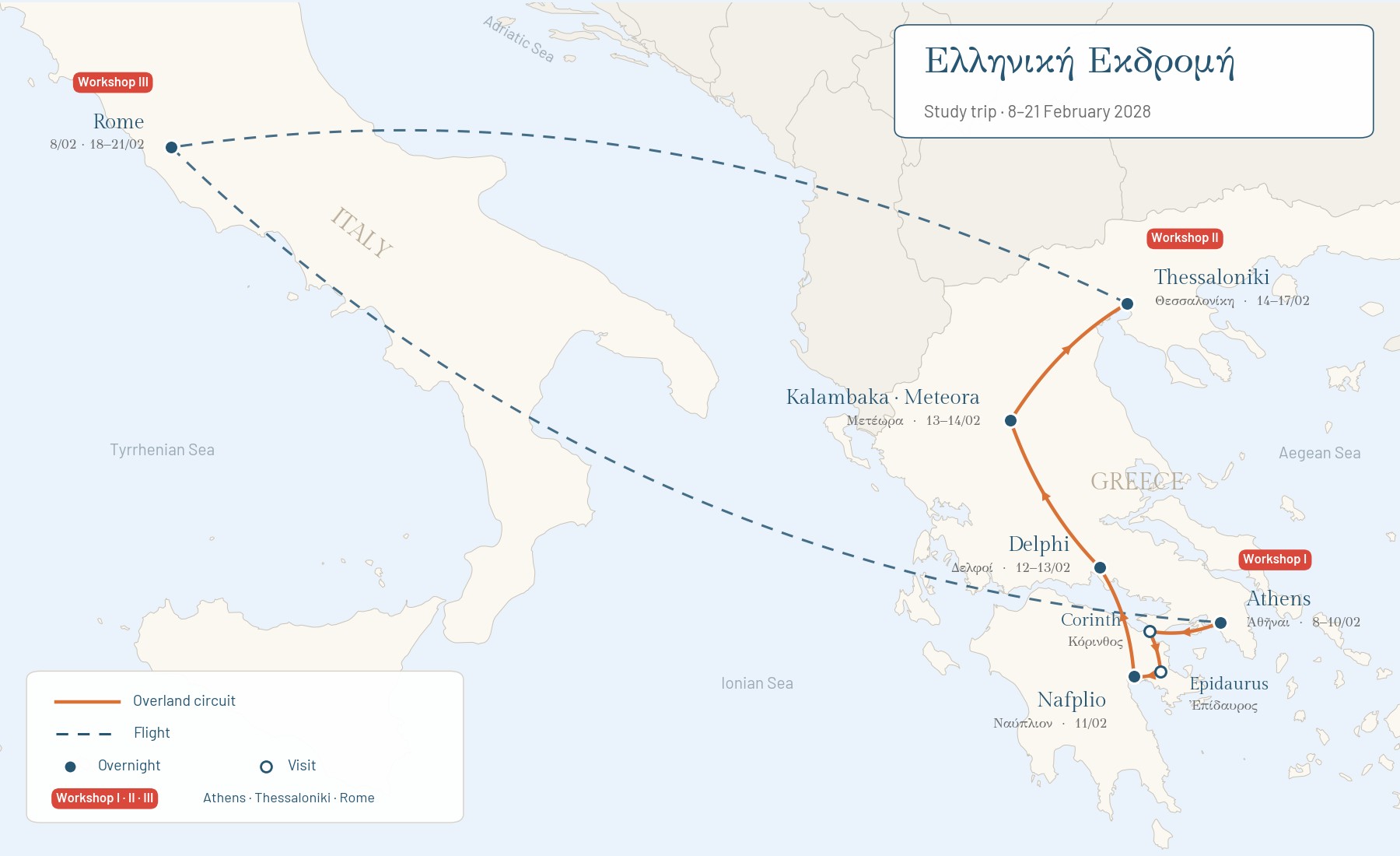
From 8 to 21 February 2028, the group travels through classical Athens, the Peloponnese, the sanctuary of Delphi, the monasteries of Meteora and Byzantine Thessaloniki, ending in Rome. Alongside the guided visits there are three half-day workshops, one at each stage, devoted to three figures of beauty in the Platonic and Christian tradition —luminous, cosmic and divine—, from Plato to Nicholas of Cusa.
ROUTE
WORKSHOPS
Workshop I
Athens · 10 February
Plato and Luminous Beauty
The ascent towards the beautiful in the Symposium (210a–212a) and the analogy of the sun in the Republic (VI, 507b–509c): beauty as what shines forth most clearly (Phaedrus 250d) and the Greek origin of the metaphysics of light later inherited by Neoplatonism and the Corpus Dionysiacum.
Workshop II
Thessaloniki · 16 February
Maximus of Chrysopolis and Cosmic Beauty
Creation as cosmic liturgy: the logoi of creatures in the Logos (Ambigua) and the Mystagogy as a reading of the cosmos and the church, in dialogue with Dionysius’ Celestial Hierarchy and with Hans Urs von Balthasar’s interpretation.
Workshop III
Rome · 21 February
Nicholas of Cusa and Divine Beauty
The sermon Tota pulchra es (1456) and De visione Dei: divine beauty as the coincidence of the visible and the invisible, and the Latin reception of Dionysius in Cusanus, who rests in San Pietro in Vincoli.
DAY-BY-DAY PROGRAMME
| Date | Stage | Activity |
|---|---|---|
| 8/02 | Rome · Athens | Meeting at Rome-Fiumicino airport and group flight to Athens. Transfer to the hotel and walk through Plaka. |
| 9/02 | Athens | City tour: Syntagma, Panathenaic Stadium, Academy of Athens. Acropolis —Propylaea, Athena Nike, Erechtheion and Parthenon— and Acropolis Museum. |
| 10/02 | Athens | Workshop I. Free afternoon. |
| 11/02 | Corinth · Epidaurus · Nafplio | Corinth Canal and the ancient theatre of Epidaurus. Arrival in Nafplio. |
| 12/02 | Nafplio · Delphi | Journey through Central Greece, crossing the Gulf of Corinth, to Delphi. |
| 13/02 | Delphi · Kalambaka | Sanctuary of Apollo, Sacred Way, theatre, stadium and Archaeological Museum of Delphi. Journey through Thessaly to Kalambaka. |
| 14/02 | Meteora · Thessaloniki | Orthodox monasteries of Meteora and transfer to Thessaloniki. |
| 15/02 | Thessaloniki | White Tower, Arch of Galerius, Rotunda, Church of Saint Demetrius and Byzantine walls. Museum of Byzantine Culture. |
| 16/02 | Thessaloniki | Workshop II. Free afternoon. |
| 17/02 | Thessaloniki · Rome | Return flight to Rome. |
| 18/02 | Rome | Pantheon and Piazza Navona. |
| 19/02 | Rome | Vatican Museums, Saint Peter’s and the Scavi. Circus Maximus and an evening in Trastevere. |
| 20/02 | Rome | Forum and Colosseum, or Villa and Galleria Borghese. Free afternoon. |
| 21/02 | Rome | Workshop III. Farewell lunch. |
RECTORATE
Rector
Juan Francisco Franck
Pro-Rectors
Pablo Adrián Cavallero
Haris Papoulias
Participation is by personal invitation of the Areopagiticum Foundation.