
LUX INTELLIGIBILIS
Investigation on the Metaphysics
of the Light of the Greeks
“Having discovered the lucidity of things is a great merit of the Greeks. By deepening this discovery, they arrived at a metaphysics of light. They were able to do this because they regarded the world as a sensible sign of a higher reality situated beyond it, and therefore they saw what is grasped by the senses as a path toward the intelligible.”
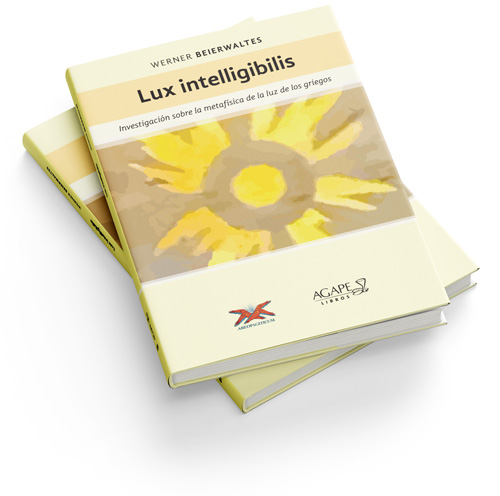
The text presented in this volume of Lux intelligibilis was conceived by Werner Beierwaltes as a dissertation to obtain the doctoral degree in philosophy. His research begins by recognizing the symbolic function of light in the central texts of Greek antiquity. The analysis revolves around the theophany, or divine manifestation, through luminous images, and then proceeds to develop a metaphysics from the Platonic perspective of the intelligibility of light. This is a programmatic work that originally presents the topics that would later be developed by the author throughout his academic career and written production. Beierwaltes thus begins his journey through the central themes of Neoplatonic reception and thought, which he would continue with figures such as Eriugena, Eckhart, and Nicholas of Cusa.
Lux intelligibilis, currently an incunabulum in its only German edition, appears here for the first time published in another language. This precise translation by Tadeo Lima, with careful treatment of the Greek text and the critical apparatus by Ezequiel Ludueña, is accompanied by an Introduction by Claudia D’Amico on the person and work of Werner Beierwaltes and a valuable Preliminary Study by Enrico Peroli, which together make it possible to appreciate the immense contribution of the original writing.
Brief Portrait of Werner Beierwaltes and His Work
The study of the history of philosophy can be conceived as the task of an antiquarian. Just as one studies a museum piece, texts that are separated from us by several centuries are reread. Another possibility is to disregard their context and simply focus on the arguments, insofar as we can classify them as rational and capable of generating a certain tension with contemporary philosophy. Without diminishing these perspectives, there is a way of turning the study of the history of philosophy into a philosophical question framed within a context of discussion. This approach seeks a critical and productive appropriation of a thought from another time, while also offering something to think about. In this sense, doing the history of philosophy is a way of doing philosophy in which thinking knows itself in time and recognizes itself in the unfolding of concepts that take on new forms.
Werner Beierwaltes (1931–2019) enriched the outlook of dozens of historians of philosophy by granting us the audacity to philosophize. The vitality that emerges from his texts reveals the pulse of a philosopher who develops his work by engaging the philosophical tradition through notions understood from a historical point of view. The One, the multiple, relational unity, identity, difference, otherness, dialectic, negation, anagogy—these are rethought within the reconstruction of a philosophical tradition: the Platonic tradition. The path he chose does not focus on presenting thinkers and their historical periods, but rather on the history of concepts. This hermeneutical praxis concerning concepts, which at times does not avoid reference to the Gadamerian notion of horizon, is, for Beierwaltes, philosophy itself in practice.
His first work, produced as a doctoral dissertation in the 1950s, already bears this mark: a concept, Lux intelligibilis, and a perspective in its subtitle: Untersuchungen zur Lichtmetaphysik der Griechen, investigations that demonstrate that what he calls a “metaphysics of light” was constituted among the Greeks¹. From then on, important monographic studies, all thesis-driven, reveal the distinctive character of his work: to present a continuity that begins with Plato and reaches, first though not last, his late-antique followers, the so-called “Neoplatonists.” He devoted two fundamental early studies to them: Proklos. Grundzüge seiner Metaphysik (Frankfurt, 1965), and Plotin. Über Ewigkeit und Zeit (Enneade III 7). Übersetzt, eingeleitet und kommentiert (Frankfurt, 1967).
Yet the strength of Beierwaltes’ thought lies precisely in not closing the history of Platonism with Neoplatonism and the closing of the Academy of Athens by Justinian in 529, but in constructing a Platonism extended and transformed up to the dawn of contemporary thought and beyond. His perspective is not chronological but conceptual. This remarkably powerful thesis finds its first formulation in the foundational Platonismus und Idealismus (Frankfurt, 1972). In this text, he presents both philosophical traditions in continuity, showing that their bond would not have been possible without the redefinitions of Christian Platonism by authors such as Augustine of Hippo and Meister Eckhart.
Among the many works that followed, one cannot fail to mention Identität und Differenz. Zum Prinzip cusanischen Denkens (Frankfurt, 1980). Despite its subtitle, this monumental work reconstructs the history of the concepts of identity and difference from their Greek expressions in Plato, Proclus, and Dionysius the Areopagite, through their late-antique Latin continuity in Marius Victorinus and Augustine, their medieval development in Meister Eckhart, their transformation in Nicholas of Cusa and Giordano Bruno, their reconfiguration in Schelling and Hegel, and their culmination in Adorno. The work concludes with a sharp critique of Heidegger’s interpretation of Western metaphysics as the forgetting of being, accusing Heidegger of overlooking the late-antique and medieval Neoplatonic tradition.
A third major work centers on what may be the fundamental concept structuring his thought: the One, in Denken des Einen. Studien zum Neuplatonismus und dessen Wirkungsgeschichte (Frankfurt, 1985). The so-called Wirkungsgeschichte—the history of the effects or influence of Neoplatonism—extends into the twentieth century. Once again, a concept understood across multiple horizons: the “One” as the key to the relation between identity and difference.
Beierwaltes also emphasized that Platonism could not have extended in this way without the transformation it underwent through Christianity. This is the perspective of Platonismus im Christentum (Frankfurt, 1998), written at the request of Giovanni Reale. Here Beierwaltes argues not for the “Christianization” of Plato, nor for a so-called “Christian Platonism,” but for evaluating the presence of Platonism in Christian thinkers who constructed a true “philosophical theology.” Philosophy and theology are not presented as opposites but as two movements with a single object: the Absolute.
Among his final works are Fussnoten zu Plato (Frankfurt, 2011) and Catena Aurea. Plotin, Augustinus, Eriugena, Thomas, Cusanus (Frankfurt, 2017). In the introduction to Fussnoten zu Plato, Beierwaltes evokes Whitehead’s dictum that all European philosophy consists of footnotes to Plato. For him, these “footnotes” represent the metamorphosis of genuinely Platonic philosophy into new forms of thought that nonetheless live essentially from their origins.
The illuminating words of Beierwaltes apply not only to the thinkers he studied—forming a kind of invisible catena aurea or golden chain throughout history—but also to his own philosophy as part of that chain, a gift to our time from the shoulders of giants.
Beierwaltes taught at the universities of Würzburg, Münster, Freiburg, and Munich. In 1996 he was named Doctor Honoris Causa of the University of Ioannina (Greece). His works have been translated into several languages.
Claudia D’Amico
Ph.D. in Philosophy; Professor of Medieval Philosophy at the University of Buenos Aires and the National University of La Plata; Principal Researcher, CONICET, Argentina.
¹ I will not address its content here, as Dr. Enrico Peroli develops it in the specific Introduction to this book.
² W. Beierwaltes, Fussnoten zu Plato, Frankfurt am Main, Klostermann, 2011, Preliminary Note, pp. VIII–IX (my translation).
³ Cf. G. Reale, “Introduzione” in Pensare l’ Uno, Milan, Vita e Pensiero, 1991, p. 20.

Werner Beierwaltes
(1931-2019)
Lux intelligibilis: Investigation on the Metaphysics of Light of the Greeks
/ Werner Beierwaltes. – 1st ed. – Autonomous City of Buenos Aires :
Agape Libros, 2024.
280 pp. ; 22 x 15 cm.
ISBN 978-987-640-734-2
1. Classical Philosophy. I. Lima, Tadeo, trans. II. Title.
CDD 193
© Agape Libros, 2024
© Fundación Areopagiticum, 2024
frontdesk@areopagiticum.org – https://areopagiticum.org/
ISBN: 978-987-640-734-2
Translation from the original German: Tadeo Lima
Review of the translation, Greek citations, and scholarly notes: Ezequiel Ludueña
Cover design: María Julia Irulegui
Layout: Agape Editorial Team
Cover illustration: Sol invictus © Gustavo A. Riesgo for Fundación Areopagiticum